
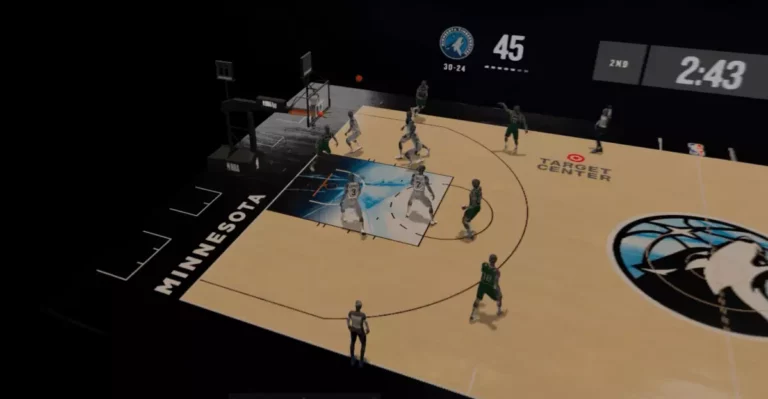
The convergence of sports and technology has accelerated over the past few years, particularly with the rise of virtual and augmented reality applications. As a prime example of this evolution, the NBA has recently rolled out an innovative feature called “Tabletop” for its NBA League Pass subscribers, utilizing Apple’s Vision Pro app to elevate the viewing experience of live games. This development not only enhances fan engagement but also signals a broader trend toward immersive sports viewing that could redefine how fans interact with their favorite leagues.
The introduction of the Tabletop feature marks a significant advancement in how basketball games are consumed. By rendering a digital basketball court in the viewer’s own space, fans are provided with a unique perspective that traditional broadcasts cannot replicate. This immersive experience allows virtual avatars of actual players to join the user in their environment, dynamically mimicking gameplay. Such technological innovations serve to bridge the gap between in-arena excitement and home viewing, bringing a slice of live-action directly to the living room.
Additionally, the nuanced design of the avatars, while somewhat basic, allows fans to identify players by jersey colors and numbers—a crucial feature that enhances the overall experience. Even though the avatars are uniform in appearance, the integration of names above the players as they handle the ball offers a simplistic yet effective solution for maintaining clarity. The NBA’s commitment to refining this immersive technology is evident, as the early iterations, despite being described as an alpha feature, showcase a surprising level of polish and functionality.
Addressing Latency: A Key Challenge
While the experience offered by Tabletop is intriguing, it is not without its challenges. The reported latency issues, which noted a delay of approximately 45 seconds compared to traditional broadcasting, pose a potential roadblock for immersive experiences. Although some users, like Vision Pro owner Justin Ryan, found ways to sync the app to the live feed effectively, finding a consistent solution for latency is critical. Any significant delay could hamper the excitement of real-time gameplay, making it essential for developers to refine the synchronization capabilities further.
Such technological nuances must be addressed to ensure that fans enjoy seamless engagement with the game. The success of features like Tabletop could hinge on the NBA’s ability to not only deliver cutting-edge innovations but also ensure that those innovations work flawlessly in tandem with live broadcasts.
The game-changing potential of the Tabletop feature reaches beyond just basketball. As leagues continue to seek ways to engage and expand their fan bases, augmented reality can serve as a promising avenue. By creating environments where fans feel integral to the action, leagues can foster a more personalized experience, which is evident in the success of similar technologies in motorsport and other entertainment sectors.
Furthermore, this ESPN-like development of AR technology hints at the likely future evolution of sports broadcasting. As consumers become increasingly accustomed to engaging with digital platforms in personalized ways, traditional formats may need to adapt or risk becoming obsolete. Such innovations not only attract younger audiences but also provide extended functionalities that could, for instance, allow fans to interact with other viewers or experience multi-dimensional narratives during each game.
The Future of Interactive Sports Watching
The NBA’s foray into augmented reality could be a pivotal step in a much larger technological transformation across sports. As the Tabletop feature shows, the importance of audience engagement is paramount, and technology plays a crucial role in attaining that goal. By integrating AR into live sports, leagues are setting the foundation for a future where viewing experiences are decentralized, interactive, and tailored to the individual preferences of users.
The potential for AR technologies like Tabletop will continue to evolve, and if the NBA successfully addresses hurdles like latency, the feature can serve as a definitive blueprint for other sports organizations. Ultimately, as technology progresses, fans can look forward to increasingly immersive and interactive experiences that blend the thrill of live sports with digital sophistication. The race for a comprehensive AR experience in sports fandom has officially begun, and it will be exciting to watch how this narrative unfolds.

- BYD’s Lingyuan: A New Era of Vehicle-Integrated Drone Technology - June 23, 2025
- The Rise of Xiaomi: An Overview of the Company’s Latest Innovations - June 23, 2025
- Ikea Enters the Thread Realm: The Timmerflotte Sensor - June 23, 2025
Leave a Reply