
Since its release in 1993, Doom has stood as a pioneering force in the gaming industry, shaping the first-person shooter (FPS) genre and influencing countless developers. More than just a game, Doom has become a symbol of technological innovation, often used as a benchmark to test the adaptability of hardware. Over the decades, programmers and hobbyists have pushed the limits of what is possible, running Doom on an ever-growing list of unconventional devices.
This passion for experimentation has evolved beyond mere novelty, transforming into a playful yet serious challenge within the tech community. The latest and most ambitious endeavor? Running Doom on a quantum computer, a feat that bridges classic gaming nostalgia with cutting-edge computational advancements.
Running Doom on Everything: A Gamer’s Experimentation Playground
Few games have been subjected to as many bizarre adaptations as Doom. Over the years, programmers have taken it upon themselves to make the game run on the most unlikely hardware imaginable. From graphing calculators and ATMs to smart fridges and pregnancy tests, Doom has proven itself to be one of the most versatile pieces of software ever created.
Even biological mediums like moldy potatoes have been exploited in an effort to render some form of gameplay. This trend is not just about showcasing technical prowess, but also about testing hardware flexibility and the limits of modern computing. Each adaptation of Doom serves as a testament to creativity and ingenuity, proving that where there’s a screen (or a circuit), there’s a way to play Doom.
Quandoom: Bringing Doom into the Realm of Quantum Computing
Taking the Doom-porting challenge to unprecedented heights, GitHub user Lumorti has developed Quandoom, a quantum computing adaptation of the iconic game. Unlike conventional hardware, which operates using binary (0s and 1s), quantum computers leverage qubits—subatomic particles that exist in multiple states simultaneously. This allows for complex calculations and parallel processing at an unmatched scale.
While Quandoom remains in its early conceptual stages, the fact that a game originally designed for 32-bit systems and floppy disks is being rewritten for quantum processing units speaks to the limitless potential of this emerging technology. Even though fully functional quantum gaming remains a distant reality, Quandoom provides a tantalizing glimpse into what the future could hold.

The Impossibility of Running Doom on Current Quantum Hardware
Despite the groundbreaking nature of Quandoom, the reality is that modern quantum computers are far from capable of running Doom in any playable form. The project demands an estimated 70,000 qubits and 80 million logic gates, while today’s most advanced quantum computer, developed by Atom Computing, has only 1,225 qubits. This enormous discrepancy highlights the technological hurdles that must be overcome before quantum computing becomes viable for mainstream gaming.
Current quantum systems struggle with error rates, coherence times, and qubit stability, making them ill-equipped to handle even the simplified rendering of a 30-year-old game. Nevertheless, Quandoom serves as a crucial step forward, demonstrating that quantum computing could one day revolutionize not just gaming, but computational science as a whole.
Quandoom: A Simplified Quantum Adaptation of Doom
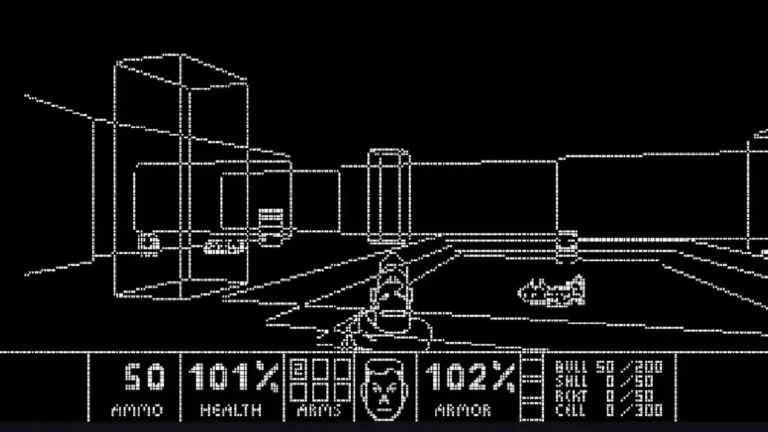
Due to quantum hardware limitations, Quandoom is a far cry from the original Doom experience. The game had to be stripped down to its bare essentials, featuring rudimentary wireframe graphics, no sound, and highly simplified enemy AI. The fast-paced, adrenaline-fueled gameplay of Doom is impossible to replicate on a system that processes information fundamentally differently from classical computers. Instead, Quandoom operates as a technical experiment, designed to explore how quantum mechanics could process gaming logic and graphics.
Enemies do not roam freely, weapons have been modified, and gameplay mechanics are constrained by the probabilistic nature of quantum operations. While it falls short as a playable game, Quandoom successfully demonstrates the merging of quantum computing and game development, marking the beginning of a new frontier in digital experimentation.
Quantum Computing Constraints and the Challenges of Gaming
Developing a game like Doom for quantum computing is an immense challenge due to the fundamental differences between classical and quantum processing. Unlike traditional computers that rely on binary operations (0s and 1s), quantum computers leverage qubits, which can exist in multiple states simultaneously through superposition and entanglement.
This makes programming for quantum systems entirely different from conventional game development. Quandoom required an estimated 8,000 lines of C++ code to manage quantum registers, reversible computing logic, and probabilistic mechanics—all of which differ drastically from traditional algorithms. This project not only highlights the complexities of quantum-based gaming but also serves as an early experiment in merging theoretical physics with interactive entertainment, paving the way for more advanced applications in the future.
What This Means for the Future of Gaming and Quantum Computing
Although Quandoom is far from a fully playable game, it provides a tantalizing glimpse into the future of quantum-powered gaming. Quantum computing has the potential to redefine game development through ultra-realistic simulations, AI-driven game mechanics, and complex physics models that would be impossible to achieve with classical computing. For example, AI opponents could make decisions based on quantum probability, creating truly unpredictable and intelligent gameplay.
Additionally, massively parallel computing could generate immersive, procedurally generated worlds with infinite complexity. However, the field is still in its infancy, and we are years—if not decades—away from seeing fully quantum-driven games. Still, projects like Quandoom showcase how quantum mechanics and gaming can intersect, hinting at a revolutionary shift in interactive entertainment.
Doom’s Legacy: A Symbol of Gaming Innovation Across Generations
From floppy disks to quantum computing, Doom has proven itself to be one of the most enduring and adaptable games in history. It has been used as a benchmark for technological experimentation, inspiring generations of developers to push hardware limitations and expand the boundaries of what gaming can achieve.
Whether running on toasters, smartwatches, or now quantum circuits, Doom continues to be a cultural and technological phenomenon that embodies creativity, persistence, and the spirit of innovation. While Quandoom is still an early concept, its very existence reaffirms Doom’s role as a catalyst for groundbreaking ideas in gaming. It may not be a quantum breakthrough just yet, but it represents the limitless ambition of developers who refuse to be bound by technological constraints.
Final Thoughts
The Intersection of Gaming and Quantum Technology
The journey of Doom from a classic FPS to an experimental quantum computing project is a testament to how far gaming has come and how much further it can go. While quantum-powered gaming is still theoretical, projects like Quandoom push the boundaries of innovation and spark curiosity about what gaming could look like in a post-classical computing era.
Recap of Key Takeaways
✔️ Doom has long been used as a testing ground for unconventional hardware, from calculators to refrigerators.
✔️ Quandoom represents the first attempt at bringing gaming to quantum computing, despite its current limitations.
✔️ Quantum gaming could revolutionize AI, physics simulations, and rendering, but the technology is not yet ready.
✔️ The project showcases the persistence and ingenuity of developers, proving that innovation never stops.
Join the Conversation!
What do you think about Doom running on quantum hardware? Do you believe quantum computing will eventually change gaming? Leave your thoughts in the comments below! Let’s discuss where the future of gaming is headed.

Leave a Reply